

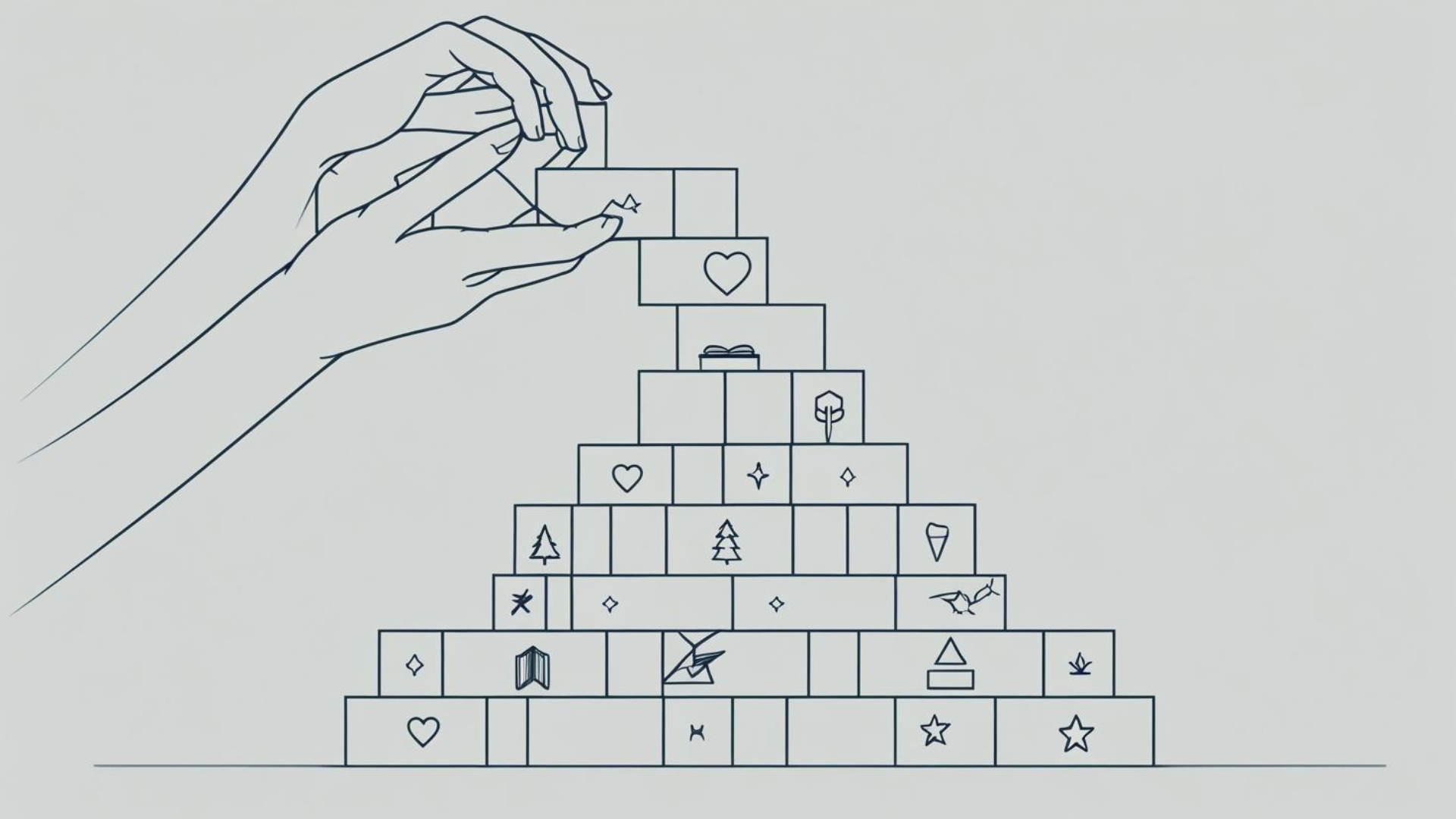
“The meaning of life is to find your gift. The purpose of life is to give it away.” — Pablo Picasso
In the quiet hours before dawn, when the world holds its breath between night and day, we often find ourselves confronting the most fundamental question of human existence: What makes a life worth living? This inquiry, as old as consciousness itself, reveals something profound about our species—we are meaning-making creatures, architects of our own purpose, builders of significance from the raw materials of experience.
Unlike other creatures who live by instinct alone, humans possess the unique capacity to construct meaning from chaos, to build cathedrals of purpose from the scattered stones of daily existence. We are not merely inhabitants of life; we are its conscious designers, crafting meaning through the deliberate choices we make, the relationships we nurture, and the creative expressions we dare to manifest.
This architectural metaphor is more than poetic flourish—it reflects a fundamental truth about how meaning operates in human life. Like any enduring structure, a meaningful existence requires careful planning, solid foundations, and the courage to build something that will withstand the inevitable storms of uncertainty and loss. But what are the blueprints for such a life? How do different cultures and wisdom traditions approach this essential construction project? And what does modern research tell us about the materials and methods that create the most fulfilling human experiences?
The Foundation: Understanding Meaning’s Essential Nature
Before we can build, we must understand what we’re building with. Meaning, in its most essential form, is the coherent narrative we create to connect our experiences, values, and aspirations into a unified whole. It’s the invisible thread that weaves disparate moments into a tapestry of purpose, transforming mere existence into something worth celebrating.
Viktor Frankl, the Holocaust survivor and psychiatrist who founded logotherapy, observed that those who survived the concentration camps were not necessarily the physically strongest, but those who maintained a sense of meaning even in unimaginable suffering. His research, documented in “Man’s Search for Meaning,” revealed that humans can endure almost anything if they can find purpose in their suffering.
Contemporary psychological research has validated Frankl’s insights with remarkable precision. Dr. Kristin Layous and her colleagues at the University of California, Riverside, found that people who report high levels of meaning in life show increased activity in the prefrontal cortex—the brain region associated with planning, decision-making, and emotional regulation. Their longitudinal studies demonstrate that individuals with a strong sense of purpose live longer, report better mental health, and show greater resilience in the face of adversity.
But meaning is not a monolith. Research by psychologists Samantha Heintzelman and Laura King reveals that meaning operates on three distinct but interconnected levels: coherence (the sense that life makes sense), purpose (goal-directed activity), and significance (the feeling that life has worth and value). Like a three-legged stool, remove any element and the entire structure becomes unstable.
The Eastern Blueprint: Dharma and the Art of Righteous Living
In the ancient Sanskrit traditions of India, the concept of dharma provides perhaps the most sophisticated framework for building a meaningful life. Dharma, often translated as “duty” or “righteousness,” encompasses a much richer understanding—it’s the unique way each individual can contribute to the cosmic order through their particular talents, circumstances, and calling.
The Hindu tradition recognizes four primary life goals, known as the purusharthas: dharma (righteous living), artha (material prosperity), kama (pleasure and emotional fulfillment), and moksha (spiritual liberation). This framework acknowledges that meaning emerges not from the pursuit of any single element, but from the dynamic balance of all four dimensions.
The Bhagavad Gita, one of Hinduism’s most profound philosophical texts, explores this balance through the story of Arjuna, a warrior facing a moral crisis on the battlefield. Krishna’s counsel to Arjuna reveals the architecture of dharmic living: act according to your nature and duty, but without attachment to outcomes. This concept of nishkama karma—desireless action—suggests that meaning comes not from achieving specific results, but from the integrity with which we engage our chosen work.
Buddhism offers a complementary perspective through the Noble Eightfold Path, which can be understood as a construction manual for a meaningful life. The path integrates ethical conduct (right speech, action, and livelihood), mental cultivation (right effort, mindfulness, and concentration), and wisdom (right understanding and intention). This holistic approach recognizes that meaning cannot be built on wisdom alone—it requires the integration of thought, word, and deed.
Research by psychologist Tim Kasser at Knox College supports these ancient insights. His studies show that people who prioritize intrinsic values (personal growth, relationships, community contribution) report higher levels of well-being than those focused primarily on extrinsic goals (wealth, fame, image). The Eastern emphasis on inner development and service to others aligns remarkably with contemporary findings about what creates lasting fulfillment.
The Western Foundation: Individualism and Authentic Self-Expression
Western philosophy has traditionally approached meaning through the lens of individual agency and authentic self-expression. From Aristotle’s concept of eudaimonia (flourishing through virtue) to the existentialist emphasis on radical freedom and responsibility, Western thought has consistently emphasized the individual’s capacity and obligation to create their own meaning.
Aristotle’s Nicomachean Ethics provides a sophisticated blueprint for human flourishing. His concept of eudaimonia suggests that meaning comes not from pleasure or external achievements, but from the actualization of human potential through virtuous activity. Aristotle identified both intellectual virtues (like wisdom and understanding) and moral virtues (like courage and justice), arguing that a meaningful life requires the cultivation of both dimensions.
The existentialist movement, led by philosophers like Jean-Paul Sartre and Simone de Beauvoir, pushed this individualistic approach to its logical extreme. Sartre’s famous declaration that “existence precedes essence” means that humans are not born with a predetermined purpose—we must create our own meaning through the choices we make. This radical freedom is both terrifying and liberating, placing the entire burden and privilege of meaning-creation squarely on individual shoulders.
Contemporary research validates aspects of both classical and existentialist approaches. Dr. Ryan and Deci’s Self-Determination Theory identifies three universal psychological needs: autonomy (the need to feel volitional and self-directed), competence (the need to feel effective and capable), and relatedness (the need for connection and belonging). Their studies across multiple cultures show that satisfaction of these needs predicts well-being and meaningful engagement regardless of specific cultural context.
However, the Western emphasis on individualism has limitations that become apparent when examined through a cross-cultural lens. Research by psychologist Shigehiro Oishi at the University of Virginia reveals that while personal achievement and self-expression are important components of meaning, they become hollow without connection to something larger than oneself.
The Indigenous Wisdom: Reciprocity and the Web of Connection
Indigenous wisdom traditions from around the world offer a third architectural approach that emphasizes reciprocity, interconnection, and responsibility to future generations. These traditions, often dismissed by modern society, contain sophisticated understandings of how meaning emerges from our relationships with community, nature, and the sacred.
The Lakota concept of mitákuye oyás’iŋ (“all my relations”) illustrates this interconnected worldview. In Lakota understanding, meaning cannot be separated from the web of relationships that connect all beings. Every action ripples through this web, affecting not just the individual but the entire community of life. This perspective naturally generates a sense of responsibility and purpose that extends far beyond personal fulfillment.
Similarly, the African philosophical tradition of Ubuntu—”I am because we are”—locates meaning not in individual achievement but in the quality of our relationships and our contribution to communal well-being. Ubuntu recognizes that human beings are fundamentally interdependent, and that individual meaning is inseparable from collective flourishing.
Research by anthropologist Robin Wall Kimmerer, author of “Braiding Sweetgrass,” reveals how indigenous gift economies create meaning through reciprocal relationships with the natural world. Unlike market economies based on scarcity and competition, gift economies operate on principles of abundance and gratitude. Kimmerer’s work shows how these practices generate profound sense of meaning and connection that mainstream culture often lacks.
Environmental psychologist Rachel Kaplan’s research supports these insights, demonstrating that people who spend time in nature and feel connected to the natural world report higher levels of meaning and life satisfaction. Her Attention Restoration Theory suggests that natural environments not only restore our cognitive capacity but also reconnect us to larger patterns of meaning and purpose.
The Creative Imperative: Expression as Sacred Architecture
Across all cultures and traditions, creative expression emerges as a universal pathway to meaning. Whether through art, music, storytelling, or craft, humans seem compelled to transform their inner experiences into external forms that can be shared and celebrated. This creative imperative suggests something fundamental about how meaning operates in human life.
The psychologist Mihaly Csikszentmihalyi’s research on flow states reveals why creative expression is so central to meaningful living. Flow occurs when we engage in activities that perfectly match our skills with appropriate challenges, creating a state of effortless concentration and deep satisfaction. Csikszentmihalyi found that people who regularly experience flow in creative pursuits report higher levels of meaning and life satisfaction.
But creativity’s relationship to meaning goes deeper than individual satisfaction. Anthropologist Ellen Dissanayake argues that artistic expression is a fundamental human adaptation, serving to create meaning and social cohesion. Her research across cultures shows that artistic activities—from cave paintings to contemporary poetry—serve to “make special” ordinary experience, elevating it to the realm of the sacred and meaningful.
The neurobiological research of Dr. Charles Limb at Johns Hopkins University provides fascinating insights into creativity’s role in meaning-making. Using fMRI technology to study jazz musicians during improvisation, Limb discovered that creative expression involves a complex interplay between self-expression and letting go of self-conscious control. This neurological dance mirrors the spiritual insights of many traditions about the relationship between individual will and surrender to something greater.
The Relational Foundation: Love as Life’s Primary Architecture
Perhaps no element of meaningful living has been more consistently identified across cultures than the centrality of loving relationships. From the Greek concept of agape (unconditional love) to the Buddhist cultivation of loving-kindness, from the Christian commandment to “love your neighbor as yourself” to the Islamic emphasis on compassion and community, human wisdom traditions unanimously recognize love as the foundation of meaningful existence.
The Harvard Study of Adult Development, led by psychiatrist Robert Waldinger, represents the longest-running study of human happiness in existence. Following participants for over 80 years, the research consistently demonstrates that the quality of our relationships is the strongest predictor of life satisfaction and meaning. As Waldinger summarizes: “Good relationships keep us happier and healthier. Period.”
But not all relationships contribute equally to meaning. Research by psychologist Arthur Aron reveals that relationships characterized by “self-expansion”—those that challenge us to grow, learn, and become more than we could be alone—contribute most significantly to our sense of meaning and purpose. These relationships, whether romantic, familial, or platonic, create what Aron calls “inclusion of other in self,” expanding our identity and capacity for meaning-making.
The neuroscientist Matthew Lieberman’s research on social connection reveals why relationships are so fundamental to meaning. His studies show that social rejection activates the same brain regions as physical pain, while positive social connection triggers the release of oxytocin and endorphins. We are literally wired for connection, and meaning emerges naturally from our ability to love and be loved.
The Choice Architecture: Intention as the Master Builder
While culture, relationships, and creative expression provide the raw materials for meaningful living, intentional choice serves as the master builder, consciously shaping these elements into a coherent structure. The capacity to make deliberate decisions aligned with our deepest values distinguishes humans from other species and serves as the primary tool for constructing meaningful lives.
The philosopher Harry Frankfurt’s influential work on the nature of caring reveals how choice creates meaning. Frankfurt argues that we become the people we are through what we choose to care about. These choices, made over time, create the narrative structure of our lives and determine whether our existence feels meaningful or empty.
Psychological research by Dr. Sonja Lyubomirsky at UC Riverside demonstrates that while genetics and circumstances account for about 60% of our happiness levels, intentional activities under our direct control account for roughly 40%. This “40% solution” suggests significant agency in building meaningful lives through conscious choice and action.
The practice of values clarification, developed by psychologist Russ Harris in his Acceptance and Commitment Therapy approach, provides practical tools for this intentional construction. Harris defines values as “chosen life directions” that serve as a compass for decision-making. Unlike goals, which can be achieved and checked off a list, values provide ongoing guidance for building meaning through aligned action.
Integration: The Art of Meaningful Construction
The architecture of meaning, like any sophisticated structure, requires the integration of multiple elements into a coherent whole. The most fulfilling lives combine elements from various cultural traditions, personal relationships, creative expressions, and intentional choices into unique configurations that reflect individual circumstances and aspirations.
Research by psychologist Todd Kashdan on psychological flexibility reveals that the ability to adapt our meaning-making strategies to different contexts and life phases is crucial for sustained fulfillment. Rather than rigidly adhering to a single approach, psychologically flexible individuals draw from multiple sources of meaning as circumstances change.
The concept of “meaning maintenance” developed by psychologists Steven Heine and Travis Proulx suggests that humans actively work to maintain coherent meaning systems in the face of contradictory experiences. When one source of meaning is threatened or lost, resilient individuals can draw upon other sources to maintain overall coherence and purpose.
Conclusion: The Eternal Construction Project
As we step back to survey the architecture of meaning, several profound truths emerge. First, meaningful living is not a destination but an ongoing construction project that requires constant attention, care, and adaptation. Like a cathedral built over centuries, a meaningful life emerges through patient, persistent effort guided by a coherent vision.
Second, while the materials of meaning—relationships, creativity, service, growth—appear universal across cultures, the specific blueprints for meaningful living are deeply personal. Each individual must discover their own unique configuration of these elements, their own architectural style for building a life worth living.
Third, meaning is not a solo construction project. We build meaningful lives in relationship with others, drawing upon the wisdom of those who have come before us while contributing our own insights to the ongoing human conversation about what makes life worth living.
Finally, the architecture of meaning is inherently fragile and requires ongoing maintenance. Life inevitably brings storms that can damage or destroy what we have built. The capacity to rebuild, to find meaning even in loss and destruction, represents perhaps the highest form of human architectural skill.
The invitation of meaningful living is both simple and profound: to become conscious architects of our own existence, builders of purpose from the raw materials of daily experience. In a world that often feels chaotic and fragmented, the act of constructing meaning becomes both a personal necessity and a gift to the larger human community. For in building lives worth living, we contribute to the grand architecture of human flourishing, adding our unique structure to the ongoing construction of a more meaningful world.
The blueprint is yours to draw. The foundation is yours to lay. The life you build is yours to inhabit. But remember—you are not building alone. You are part of an ancient tradition of meaning-makers, architects of significance who have always known that the deepest human need is not merely to survive, but to create lives so rich with purpose that they become worthy of the consciousness that conceived them.
What will you build with the materials of this one precious life?
