

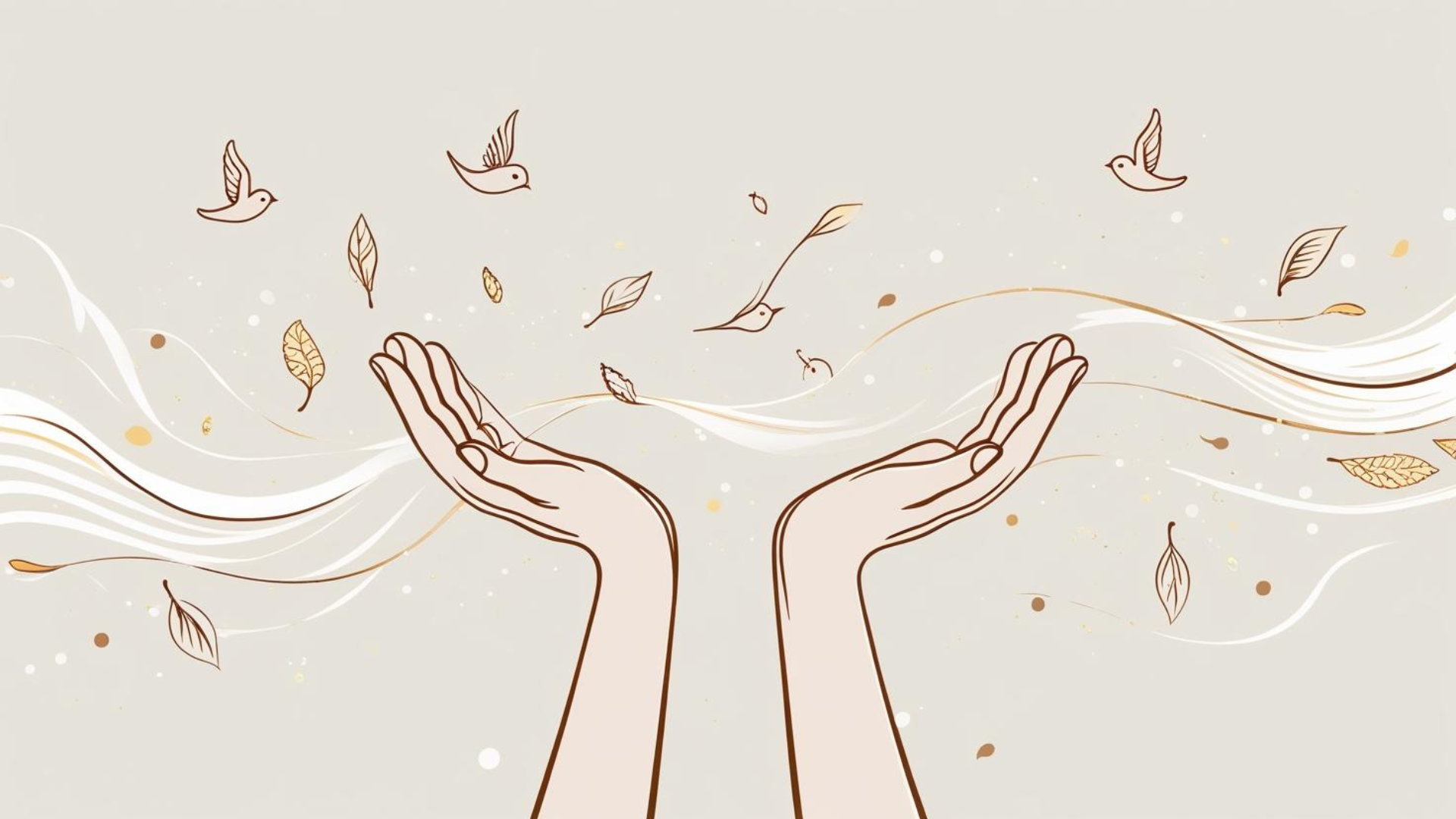
“You can only lose what you cling to.” — Buddha
In the dim light of her childhood bedroom, Elena sits surrounded by twenty-seven years of accumulated life—photographs that once captured perfect moments, books that promised to change her thinking, clothes that represented different versions of herself she’d tried to become. Tomorrow, she’ll move across the country to pursue a dream she’d nearly abandoned, but first, she must practice perhaps the most difficult art known to humans: letting go.
As she holds a letter from a relationship that ended years ago, Elena recognizes the familiar weight of attachment—that peculiar human capacity to grip experiences, identities, and expectations so tightly that they become anchors rather than treasures, chains rather than charms. The letter has no practical value, yet releasing it feels like surrendering a piece of her story, a fragment of who she used to be.
This moment illuminates the central paradox of human existence: we must hold life lightly enough to let it flow through our fingers, yet fully enough to experience its beauty. We are creatures designed for connection, yet our survival depends on our capacity for release. We accumulate experiences, relationships, and identities that shape us profoundly, then face the inevitable necessity of allowing them to transform or dissolve entirely.
The art of letting go represents perhaps life’s most essential skill, yet it receives little systematic cultivation in our education, minimal support in our culture, and inadequate understanding in our psychology. We are taught to acquire, achieve, and accumulate, but rarely instructed in the complementary arts of releasing, surrendering, and allowing. This imbalance creates profound suffering—the pain that emerges not from life’s natural changes but from our resistance to them.
Yet wisdom traditions across cultures have long recognized letting go as the foundation of freedom, the pathway to peace, and the source of genuine strength. From the Buddhist understanding of non-attachment to the Stoic practice of accepting what lies beyond our control, from indigenous ceremonies of transition to contemporary research on psychological resilience, a consistent truth emerges: our capacity for happiness depends less on what we can grasp and more on how gracefully we can release.
Psychology of Attachment: Understanding What We Hold
Before exploring the art of letting go, we must understand what makes letting go so challenging. Attachment—both to people and to outcomes—serves crucial evolutionary and psychological functions that complicate any simple approach to release.
Attachment theory, pioneered by John Bowlby and Mary Ainsworth, reveals that our capacity to form emotional bonds is not just beneficial but essential for survival and development. Secure attachment to caregivers provides the foundation for emotional regulation, social competence, and psychological resilience throughout life. The problem arises when adaptive attachment becomes maladaptive clinging—when our natural capacity for connection transforms into desperate attempts to control outcomes we cannot control.
Research by psychologist Tim Kasser on materialism and well-being demonstrates how attachment to external sources of validation—wealth, status, appearance—consistently predicts lower life satisfaction and higher levels of anxiety and depression. Kasser’s studies reveal that people who organize their lives around extrinsic goals report feeling less autonomous, less competent, and less connected to others than those who prioritize intrinsic values like personal growth, relationships, and community contribution.
The neuroscientist Antonio Damasio’s research on decision-making reveals that our brains are prediction machines, constantly generating models of future outcomes based on past experiences. These predictive models become attachments—mental representations of how we believe life should unfold. When reality diverges from our predictions, our neural alarm systems activate, generating the emotional distress we experience as resistance to change.
Dr. Judson Brewer’s research on addiction reveals that attachment and craving operate through similar neural mechanisms. Whether we’re attached to substances, behaviors, or outcomes, the brain’s reward circuits create powerful motivation to maintain familiar patterns even when they no longer serve our wellbeing. This neurological basis of attachment suggests that letting go requires not just willpower but skillful retraining of neural pathways.
Perhaps most importantly, research by psychologist Kristin Neff on self-compassion reveals that our attachments often serve as strategies for avoiding difficult emotions—particularly shame, fear, and grief. We cling to relationships, identities, or achievements because releasing them would require feeling the vulnerability of uncertainty, the sadness of impermanence, or the fear of meaninglessness. Letting go becomes possible only when we develop the emotional capacity to tolerate these difficult feelings with kindness rather than resistance.
Eastern Philosophy: The Wisdom of Non-Attachment
Eastern philosophical traditions offer perhaps the most sophisticated understandings of letting go, developed through millennia of contemplative exploration into the nature of suffering and liberation.
Buddhism identifies attachment (upādāna) as the primary source of human suffering. The Second Noble Truth teaches that our pain comes not from life’s inevitable difficulties but from our craving for things to be different than they are. This craving takes four primary forms: attachment to sensual pleasures, to views and opinions, to rites and rituals, and to theories about the self. Liberation occurs through developing what Buddhism calls “non-attachment”—the ability to engage fully with life while holding outcomes lightly.
The distinction between detachment and non-attachment proves crucial for understanding the art of letting go. Detachment involves withdrawal, emotional numbness, or spiritual bypassing—attempting to avoid engagement with life’s challenges. Non-attachment involves full engagement combined with acceptance of impermanence—loving deeply while acknowledging that all experiences and relationships are temporary.
The Buddhist concept of “letting go with love” illustrates this distinction beautifully. When we release someone or something we care about, we don’t eliminate love but transform its expression from possessive to liberating. We continue caring while releasing the need to control outcomes, continue loving while accepting change and loss as natural aspects of existence.
The Zen tradition’s understanding of “just sitting” (shikantaza) provides a profound practice for cultivating non-attachment. In zazen meditation, practitioners learn to observe thoughts, emotions, and sensations without grasping or pushing away. This practice develops what we might call “letting-go mind”—the capacity to allow experiences to arise and pass away naturally without interference from preference or resistance.
Hindu philosophy contributes the concept of “surrender” (praṇidhāna) as the ultimate form of letting go. Rather than understanding surrender as passive resignation, Hindu teaching presents it as conscious alignment with cosmic intelligence that exceeds individual understanding. The Bhagavad Gita’s teaching on “actionless action” suggests that we can engage fully with life while surrendering attachment to results, allowing outcomes to unfold according to deeper wisdom than our personal preferences.
The practice of karma yoga—selfless service—serves as training in non-attachment by encouraging action motivated by love rather than personal gain. When we serve others without expectation of reward, we naturally develop the capacity to let go of outcomes while remaining fully engaged with meaningful activity.
Taoism offers the principle of “wu wei”—effortless action that emerges from alignment with natural flow. The Tao Te Ching teaches that water, which yields to all obstacles yet eventually transforms the hardest stone, provides the perfect metaphor for skillful letting go. We develop strength through flexibility, power through yielding, and effectiveness through non-resistance to natural change.
Western Philosophy: From Stoicism to Existentialism
Western philosophical tradition has approached letting go through various frameworks, each offering unique insights into the challenge of releasing attachment while maintaining engagement with life.
Stoic philosophy, developed in ancient Greece and Rome, provides perhaps the most practical Western approach to letting go. The Stoic principle of focusing only on what lies within our control naturally generates appropriate letting go of everything that lies beyond our influence. Epictetus taught: “Some things are within our power, while others are not.” This simple distinction becomes revolutionary when applied consistently to daily life.
Marcus Aurelius’ “Meditations” demonstrate how Stoic letting go practices can be applied to leadership, relationships, and personal challenges. His approach involves neither cold detachment nor emotional suppression, but rather clear-eyed acceptance of reality combined with wholehearted engagement with appropriate action. He writes: “Accept the things to which fate binds you, and love the people with whom fate brings you together.”
The Stoic practice of “negative visualization”—imagining the loss of things we value—serves as training for letting go by reducing attachment through contemplating impermanence. Rather than generating pessimism, this practice typically increases gratitude for present circumstances while building psychological resilience for inevitable changes.
Existentialist philosophy contributes the insight that authentic living requires constant letting go of inauthentic identities and social roles that don’t reflect our genuine nature. Jean-Paul Sartre’s concept of “radical freedom” suggests that we must repeatedly release fixed ideas about who we are in order to continue creating ourselves authentically. This existential letting go becomes an ongoing practice of identity renewal rather than identity preservation.
Simone de Beauvoir’s analysis of “bad faith” reveals how we often cling to limiting identities or circumstances to avoid the anxiety of freedom and responsibility. Her work suggests that letting go becomes not just beneficial but ethically necessary—a requirement for authentic existence that honors our capacity for continuous self-creation.
Martin Heidegger’s concept of “thrownness” acknowledges that we are thrown into existence with certain givens—historical context, family circumstances, genetic inheritance—that we cannot change. Authentic existence requires accepting these conditions while taking responsibility for how we respond to them. This Heideggerian letting go involves releasing fantasy versions of our lives while fully embracing the actual conditions within which we must create meaning.
Contemporary philosopher Thomas Nagel’s work on “the view from nowhere” illuminates how letting go often requires shifting perspective from personal attachment to what he calls “objective standpoint”—seeing our individual concerns within larger contexts that naturally reduce their apparent importance while increasing our capacity for appropriate action.
Indigenous Wisdom: Ceremonial Release and Cyclical Understanding
Indigenous cultures worldwide have developed sophisticated practices for letting go that honor both the necessity of release and the grief that accompanies it. These traditions recognize letting go as a communal activity requiring ceremonial support rather than individual willpower alone.
Many Native American traditions include “give-away” ceremonies where participants release possessions, achievements, or even aspects of identity as offerings to the community. These ceremonies recognize that hoarding—whether material or psychological—disrupts the natural flow of energy through communities and ecosystems. Letting go becomes an act of spiritual hygiene that maintains healthy circulation of resources and relationships.
The Lakota understanding of “mitákuye oyás’iŋ” (“all my relations”) naturally generates appropriate letting go by locating individual identity within the larger web of relationships that includes ancestors, descendants, other species, and the earth itself. When we understand ourselves as temporary expressions of this larger web, releasing particular forms becomes less threatening because our essential nature remains connected to the whole.
Vision quest traditions provide structured opportunities for releasing old identities and allowing new ones to emerge. The practitioner goes alone into nature for several days without food, water, or shelter, creating conditions where familiar self-concepts dissolve and deeper identity can be discovered. This process demonstrates how letting go often requires not just mental decision but embodied experience of dissolution and renewal.
Australian Aboriginal concepts of “country” and “songlines” offer understanding of identity that naturally supports letting go. Individual identity is understood as temporarily embodying ancestral songs that have been sung across the landscape for thousands of years. When we understand ourselves as temporary singers of eternal songs, releasing particular performances becomes less threatening because the songs continue through other voices.
African traditions of ancestral connection provide frameworks for letting go that honor continuity within change. When someone dies, their individual form is released while their wisdom and love continue to influence the living community. This understanding of death as transformation rather than termination naturally supports letting go of attachment to particular forms while maintaining connection to essential relationships.
Research by anthropologist Arnold van Gennep on “rites of passage” reveals that traditional cultures systematically support letting go through three-phase transitions: separation from old identity, liminal period of uncertainty, and reintegration with new identity. Modern culture often lacks these supportive structures, leaving individuals to navigate major transitions without adequate community support or ritual framework.
Neuroscience of Release: How the Brain Lets Go
Contemporary neuroscience reveals the biological mechanisms through which letting go occurs, providing scientific validation for ancient wisdom while suggesting practical approaches for cultivating release.
Dr. Rick Hanson’s research on “taking in the good” demonstrates that the brain’s negativity bias makes us naturally better at holding onto painful experiences than positive ones. This neurological tendency creates what Hanson calls “the brain’s Velcro for bad experiences and Teflon for good ones.” Skillful letting go requires consciously counteracting this bias by deliberately releasing negative experiences while savoring positive ones.
Hanson’s work reveals that letting go is not passive but requires active neural processes. When we consciously release a painful memory or limiting belief, specific brain regions associated with cognitive control and emotional regulation must override default tendencies toward rumination and rehearsal. This neuroplasticity means that letting go is a skill that strengthens with practice.
Research by neuroscientist Matthew Lieberman at UCLA on “affect labeling” shows that simply naming difficult emotions begins the neurological process of letting go. When we accurately identify what we’re feeling—fear, anger, grief, disappointment—the prefrontal cortex becomes more active while the amygdala’s reactivity decreases. Naming our experience creates the neural conditions necessary for conscious release.
Dr. Dan Siegel’s research on “integration” reveals that letting go occurs most effectively when we acknowledge and honor what we’re releasing rather than trying to eliminate it. His RAIN technique (Recognize, Allow, Investigate, Nurture) demonstrates how mindful attention to difficult experiences naturally leads to their transformation and release.
Studies of psychedelic therapy by researchers like Robin Carhart-Harris at Imperial College London reveal that profound letting go experiences often involve temporary dissolution of the “default mode network”—brain regions associated with self-referential thinking and ego boundaries. These dissolution experiences appear to reset neural patterns associated with rigid attachment, creating opportunities for more flexible and adaptive responses to life circumstances.
Research on meditation’s effects on the brain consistently shows that contemplative practices associated with letting go—mindfulness, loving-kindness, and compassion meditation—literally rewire neural networks associated with attachment and release. Long-term practitioners show decreased reactivity in brain regions associated with craving and increased activity in areas associated with present-moment awareness and emotional regulation.
Practical Letting Go: Techniques and Approaches
Understanding letting go philosophically and neurologically differs significantly from developing practical capacity for release in daily life. The cultivation of letting go requires specific practices adapted to different types of attachment and various life circumstances.
Relationship Letting Go: When relationships end—whether through death, divorce, or natural transition—letting go involves grieving what was while opening to what might be. This process requires distinguishing between love (which can continue) and attachment (which must be released). Practices include writing letters you don’t send, creating rituals of appreciation and release, and consciously blessing the other person’s journey even when it diverges from your preferences.
Identity Letting Go: As we grow and change, we must repeatedly release outdated versions of ourselves—old roles, beliefs, and self-concepts that no longer serve our development. This requires what psychologists call “identity flexibility”—the capacity to hold our self-concept lightly while remaining grounded in core values. Practices include regular self-inquiry about which aspects of identity feel alive versus static, experimenting with new roles and perspectives, and celebrating identity evolution as natural development.
Expectation Letting Go: Perhaps the most frequent letting go challenge involves releasing specific expectations about how situations should unfold. This requires developing what Buddhism calls “don’t-know mind”—remaining open to possibilities we haven’t imagined. Practices include identifying attachment to particular outcomes, exploring underlying needs that expectations attempt to meet, and finding alternative ways to meet those needs that don’t depend on controlling external circumstances.
Grief as Letting Go: All letting go ultimately involves grief—mourning what was, what might have been, or what we wish could continue. Skillful letting go requires learning to grieve consciously rather than avoiding or prolonging the natural grief process. This involves allowing sadness, anger, and fear to move through us without resistance while maintaining faith that the grief process serves healing and renewal.
Material Letting Go: In consumer culture, we often accumulate possessions that become burdens rather than blessings. Material letting go involves distinguishing between things that support our values and things that merely occupy space or attention. Practices include regular decluttering based on what truly serves current life rather than past or fantasy selves, and conscious consumption that prioritizes quality and meaning over quantity and acquisition.
Forgiveness as Letting Go: Holding resentment toward others or ourselves represents attachment to past hurts that prevents present healing. Forgiveness involves letting go of the demand that past events should have been different while maintaining appropriate boundaries and learning. This requires understanding forgiveness as release for our own healing rather than absolution for others’ actions.
Control Letting Go: The illusion of control creates enormous suffering when we attempt to manage outcomes beyond our influence. Developing “control discernment” involves continuously distinguishing between what we can influence (our responses, attitudes, and actions) and what lies beyond our control (others’ choices, natural events, and social circumstances). This practice gradually shifts energy from futile control attempts toward effective response and adaptation.
Paradox of Effort: Trying and Not Trying
One of the most subtle aspects of letting go involves navigating the paradox between effort and surrender. Genuine letting go cannot be forced through willpower alone, yet it rarely happens without conscious intention and practice. This creates what we might call “the letting go paradox”—we must try to not try, effort to surrender, use will to transcend will.
Eastern traditions address this paradox through the concept of “right effort”—appropriate engagement that neither forces nor avoids. In Buddhist meditation, practitioners learn to observe experiences without grasping or pushing away, developing what might be called “effortless effort”—alert relaxation that maintains awareness without strain.
The Taoist principle of “wu wei” provides another approach to the paradox. Wu wei involves aligning with natural flow rather than opposing it, finding the path of least resistance that accomplishes desired outcomes with minimal force. This requires developing sensitivity to natural timing and organic unfolding rather than imposing artificial schedules on natural processes.
Psychotherapy research reveals similar insights about the paradox of therapeutic change. The most effective approaches honor clients’ resistance rather than trying to overcome it, recognize that healing unfolds according to organic timing rather than therapeutic agendas, and create conditions for natural healing rather than forcing particular outcomes.
Contemporary research on “behavioral change” consistently shows that sustainable transformation occurs through gradual practice and environmental modification rather than dramatic willpower efforts. This suggests that letting go develops through patient cultivation of conditions that support release rather than through forced attempts at immediate detachment.
Seasonal Letting Go: Honoring Natural Cycles
Nature provides perfect instruction in the art of letting go through seasonal cycles that demonstrate how release serves renewal. Trees don’t cling to their leaves; they release them when conditions change, trusting that new growth will emerge in appropriate season. This natural wisdom offers profound guidance for human letting go practices.
Autumn represents the most obvious natural metaphor for letting go—the season when trees release their leaves, plants complete their growing cycles, and nature prepares for winter’s restorative dormancy. Many wisdom traditions time formal letting go practices with autumn’s natural energy of release and preparation.
Winter demonstrates that letting go serves renewal rather than loss. The apparent death of winter creates conditions for spring’s rebirth. Seeds must be buried in dark earth before they can sprout; bulbs must experience cold dormancy before they can flower. Human letting go often involves similar periods of apparent emptiness that actually prepare for new growth.
Spring reveals how letting go creates space for emergence. New shoots push through old growth; fresh flowers replace last year’s blooms; young animals are born from previous year’s mating. What seemed like loss during autumn and winter reveals itself as preparation for renewal.
Summer shows how cycles of release and renewal create abundance. The harvest results from the entire yearly cycle of planting, growing, and releasing. Human development similarly requires cycles of acquiring new experiences and releasing what no longer serves, creating space for continued growth and contribution.
Research by environmental psychologist Roger Ulrich demonstrates that exposure to natural environments significantly reduces stress and promotes psychological healing. Nature connection naturally supports letting go by reminding us of larger cycles within which our individual attachments represent temporary phases rather than permanent fixtures.
Cultural Dimensions: Collective Letting Go
Individual letting go occurs within cultural contexts that either support or complicate release. Cultures that emphasize individual achievement, material accumulation, and image management often make letting go more challenging, while cultures that recognize interdependence, impermanence, and cyclical change tend to support natural release processes.
Consumer capitalism depends on attachment—encouraging us to seek satisfaction through acquisition while generating dissatisfaction that motivates continued consumption. This creates what we might call “attachment addiction”—chronic craving for external validation that makes letting go feel threatening to identity and security.
Social media amplifies attachment challenges by creating what psychologist Sherry Turkle calls “life as performance.” When identity becomes curated image, letting go of particular achievements, relationships, or experiences threatens the constructed self that gains validation through online presentation. Digital detox and mindful technology use become essential practices for maintaining capacity for healthy letting go.
Individualistic cultures often lack community support for letting go transitions, leaving people to navigate major releases—job changes, relationship endings, identity transitions—without adequate social scaffolding. Creating or finding communities that understand letting go as necessary life skill becomes crucial for sustainable practice.
Different cultures have varying comfort levels with different types of letting go. Some cultures support letting go of material attachments while encouraging strong family or tribal identities. Others promote individual flexibility while maintaining attachment to traditional practices. Understanding cultural context helps individuals navigate letting go in ways that honor both personal growth and cultural connection.
Integration: Living the Art of Release
The art of letting go ultimately becomes a way of life rather than a collection of techniques—a fundamental orientation toward existence that honors both attachment and release as necessary aspects of human experience. This integration requires developing what we might call “letting go wisdom”—the capacity to engage fully with life while holding all experiences lightly.
Master practitioners of letting go demonstrate several consistent qualities: they love deeply without possessing, commit fully while accepting uncertainty, plan carefully while remaining flexible, grieve losses completely while remaining open to new possibilities. They understand that letting go serves love rather than opposing it, enhances engagement rather than creating detachment.
This mastery develops through years of practice rather than sudden insight. Like learning to play music or speak a language, letting go improves through regular engagement with increasingly complex challenges. Each successful release builds capacity for more difficult letting go situations.
The integration of letting go transforms not just individual experience but relationships, work, and community engagement. People who practice skillful release tend to create less drama, generate more creativity, and contribute more effectively to collective wellbeing. Their capacity for change makes them valuable partners, colleagues, and community members.
Perhaps most importantly, those who master letting go often discover that what they thought they would lose through release was never truly possessed, while what they feared would disappear through letting go often returns in more beautiful and sustainable forms. They learn that love released returns as freedom, creativity released returns as inspiration, and service released returns as joy.
The Freedom Found in Release
The art of letting go ultimately reveals itself as the art of living fully—the capacity to engage completely with each moment while remaining free from the tyranny of clinging to what has passed or demanding what has not yet arrived. It offers not escape from life but deeper entry into it, not protection from loss but transformation of our relationship with impermanence itself.
This transformation challenges contemporary culture’s fundamental assumptions about security, success, and satisfaction. It suggests that true security comes not from controlling outcomes but from developing resilience to change, that genuine success includes the wisdom to release what no longer serves, and that lasting satisfaction emerges from appreciating what is rather than acquiring what isn’t.
The practice of letting go becomes particularly crucial in our historical moment, when the pace of change accelerates continuously and traditional sources of stability—careers, relationships, communities, even climate—shift rapidly. Our survival and thriving depend increasingly on our capacity to adapt, which requires releasing attachment to how things used to be while remaining open to how they might become.
Yet letting go offers more than adaptation to external change—it provides access to the deepest sources of human freedom and creativity. When we release the need to control outcomes, energy becomes available for genuine response. When we let go of fixed identity, space opens for continued growth and discovery. When we release past hurts, the heart becomes available for present love.
The ancient wisdom that teaches “you can only lose what you cling to” points to a profound truth about the nature of security and possession. What we grasp too tightly often slips through our fingers, while what we hold lightly tends to remain available to us. The rose is most beautiful when blooming freely in the garden, not when cut and grasped in a possessive hand.
The art of letting go is not about becoming indifferent to outcomes or detached from relationships. Rather, it’s about loving so deeply that we want what’s best for the people and situations we care about, even when that means releasing our preferences about how their stories should unfold. It’s about caring so much about life’s beauty that we’re willing to let each moment be what it is rather than demanding it conform to our expectations.
In the end, letting go reveals itself as the ultimate act of love—love for life’s natural flow, love for others’ freedom to make their own choices, love for our own capacity to grow beyond current limitations, love for the mystery that guides existence toward forms of beauty and meaning we couldn’t have imagined when we were busy trying to control outcomes.
The invitation of letting go is always present: to release what binds us so that what blesses us can emerge, to trust the intelligence of life more than our individual preferences, to participate in the eternal dance of holding and releasing that creates space for continuous renewal. In this dance, we discover that what we thought we were losing through letting go was never ours to keep, while what we gain through release—freedom, peace, authentic connection, creative flow—represents the treasures we were seeking all along through our clinging.
The art of letting go is the art of becoming fully alive.
